


The wavering hypothesis of pottery = agricultural societies
Pottery is not merely a daily utensil; it is like a witness that tells the story of the development of human technology and culture. In my research, I focus on elucidating the mechanisms by which hunter-gatherers in the Japanese archipelago adopted pottery-making techniques and further developed and disseminated them across diverse environments.
So, what can pottery teach us? For many people, the word “doki (pottery)” may evoke images of ancient artifacts displayed behind glass in museums. However, in fact, many descendants of pottery exist in modern society. For example, not only familiar items such as vases and bowls, but also washbasin sinks and electrical insulators attached to utility poles can broadly be considered ceramic products. In other words, pottery culture that originated in ancient times continues to be passed down and remains present in our daily lives.
On the other hand, for archaeologists, the greatest appeal of pottery lies in its role as a ruler for measuring time. While historical studies explore the past through written documents, archaeology reconstructs human activity from material remains such as sites and artifacts. In this process, pottery serves as an excellent chronological indicator. This is because the shapes, manufacturing techniques, and decorative patterns of pottery reflect trends unique to specific periods.
For instance, differences in the types of clay used, as well as the minerals or plant fibers mixed into them, reflect regional and chronological characteristics. Moreover, since the potter’s wheel did not exist at the time, vessels were formed by stacking ring-shaped strips of clay, and the stacking methods and decorative styles also had features of corresponding periods. Firing methods were also diverse, with variations in oxygen levels and temperature affecting color and texture.
By analyzing these factors in detail, archaeologists can sometimes estimate the production period from a pottery fragment of only a few centimeters in size, with an accuracy of about a hundred years. We could say that this is truly a form of craftsmanship devoted to reading time.
In recent years, perceptions of the origin of pottery have changed dramatically. Pottery used to be considered as a product of agricultural societies. Especially among European researchers, pottery technology was considered to be invented by agricultural people in the Middle East and then spread westward. According to the narrative, the convenience of watertight vessels produced by heating clay contributed to the sedentary life and the development of civilization.
However, advances in research over the past roughly 25 years have brought a completely different possibility to light. This is the idea that hunter‑gatherers in the Far East independently invented pottery as a technology unrelated to agriculture, and that it spread across northern Eurasia. We can say that this reassessment urges a major reconsideration of Eurocentric historical perspectives and sheds light on the diverse paths humanity has taken.
Did hunter‑gatherers in the Far East create pottery?
Pottery in the Japanese archipelago is believed to have emerged around 16,000 years ago. Alongside southern China, this represents some of the oldest pottery in the world and corresponds to the transition from the Paleolithic period to the Jomon period. In other words, hunter‑gatherers in the Far East were the first in the world to invent the practice of firing clay to make vessels. This fact has become widely recognized internationally over the past quarter century.
Behind this paradigm shift, there was a geographical bias in the circulation of information. Especially during the Cold War, archaeological findings from former Eastern Bloc countries such as Russia and China were not adequately transmitted to Western academia. In addition, excavation reports from vast regions were published only in local languages, and international scholarly exchange remained limited.
However, with China’s Reform and Opening-up and the post‑Soviet opening up of Russia and other former Eastern Bloc countries in the 1990s, enormous amounts of previously inaccessible data began to reach the international scholarly community in the 2000s. As a result, facts that did not align with Western researchers’ belief that pottery emerged only within settled agricultural societies came to light one after another.
For example, in China and the Russian Far East, numerous pottery vessels have been found that date back more than 10,000 years, before agriculture became widespread. Although people at the time lived as hunter‑gatherers with only limited settlement, they had already acquired the technology to fire clay and make vessels. This discovery called for a fundamental revision of the traditional Eurocentric view that regarded the invention of pottery as a product of agricultural societies.
Within these research trends, I believe that Japanese archaeology in fact holds tremendous potential. In fact, as early as the 1950s and 1960s, scholars in Japan had already shown that the emergence of pottery could not be explained by the European agricultural‑origin model.
The pioneer of this line of research was the late Professor SERIZAWA Chosuke (Professor Emeritus at Tohoku University), an archaeologist with close ties to Meiji University. In 1950 and 1955, Professor SERIZAWA was involved in excavating Natsushima Shell Midden, located just south of Tokyo, where he confirmed what was then considered the oldest pottery in the Japanese archipelago. As a result of analysis, this pottery turned out to be the oldest in the world. Based on these findings, Professor SERIZAWA presented the bold hypothesis more than 60 years ago that, independent of pottery created by West Asian farmers, hunter‑gatherers in East Asia had also invented pottery on their own.
However, at that time, Japanese research findings were disseminated only in Japanese and were rarely shared internationally. Moreover, as mentioned earlier, relevant information from Russia and China was mostly not publicly available, and Japanese discoveries were regarded as isolated anomalies and placed on hold by the international academic community for decades.
Now we need to reevaluate the potential power of materials from the Japanese archipelago. By doing so, I hope to archaeologically test the process by which hunter‑gatherers in the Far East invented pottery and spread it throughout northern Eurasia.
Japan’s historical resources could be a global intellectual foundation
By the way, do you know how many archaeological sites are confirmed in Japan today? According to the Agency for Cultural Affairs, the number amounts to as many as around 470,000 sites. Given Japan’s relatively small land area, this density is astonishing by global standards. Moreover, about 8,000 cases of excavation survey are conducted every year, and this figure is also outstanding compared with other countries.
There are very few countries in the world that carry out archaeological excavations at such a high density within a limited land area. Furthermore, Japanese archaeology maintains an extremely high standard not only in the volume of excavations, but also in the meticulous organization of artifacts and the precision of report writing. Our forerunners have accumulated an abundance of careful recording practices and analytical techniques. I regard Japanese archaeology as world‑class in both the quantity of data it produces and the care with which information is extracted from that data.
Another noteworthy fact is that numerous pottery vessels dating back 12,000 years have been found throughout the archipelago. Compared with regions outside the Far East, where the oldest pottery often dates only to between 9,000 and 5,000 years ago, this antiquity stands out. Moreover, as the land stretches long from north to south, from subarctic Hokkaido to subtropical Okinawa, and steep mountainous regions to low and flat plain regions, archaeological sites adapted to different natural environments are concentrated within a narrow scope. In other words, Japan as a whole is something like a high-precision laboratory for reproducing acts of human kind from the past.
Under such diverse environments, how did hunter-gatherers spread their pottery making skills? Clarifying this process using materials from the Japanese archipelago will not only illuminate the regional history of a Far Eastern island nation, but also contribute to the reconstruction of a global historical perspective. I am convinced that Japan’s historical resources can serve as a global intellectual foundation.
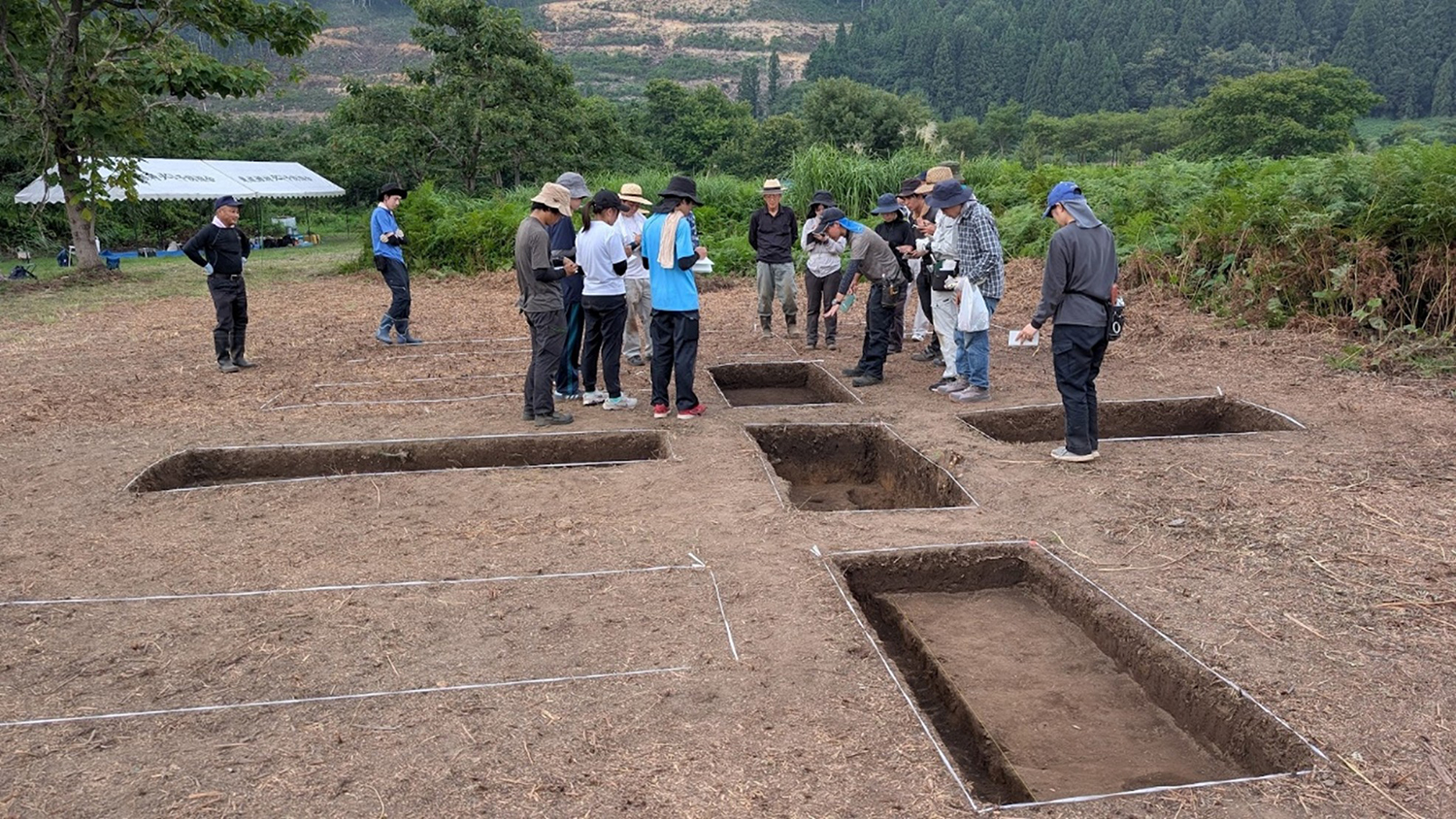
“Is archaeology useful to society?” I am often asked this question. While I believe that we should be cautious about the trend to narrowly understand the value of “usefulness,” I would say that the significance of archaeology lies in providing a perspective from which to think about society over vast spans of time.
Contemporary society sometimes appears to be complete within the present moment alone. In reality, however, every society exists within a continuous flow of time connecting past and future. By adding the fourth dimension of time to a three‑dimensional view of society, archaeology offers a perspective that allows us to grasp things in a more stereoscopic way.
Based on the materialistic traces left by people in the past, reproducing history is, so to speak, a form of communication between humans beyond time and space. I believe that this expansive perspective and imagination will transcend a value judgement of “usefulness” confined to practicality.
* The information contained herein is current as of August 2025.
* The contents of articles on Meiji.net are based on the personal ideas and opinions of the author and do not indicate the official opinion of Meiji University.
* I work to achieve SDGs related to the educational and research themes that I am currently engaged in.
Information noted in the articles and videos, such as positions and affiliations, are current at the time of production.