

Power electronics: essential for realizing a decarbonized society
Mitigating global warming and achieving a sustainable society are now pressing global challenges, with reducing carbon dioxide (CO₂) emissions, particularly in the automotive industry, at the core.
Government statistics show that, in fiscal year 2023, the transportation sector – including private cars and freight trucks – accounted for 24.1% of Japan’s total domestic energy consumption, far exceeding the household sector (14.8%) (Agency for Natural Resources and Energy, Ministry of Economy, Trade and Industry, Energy Trends June 2025 Edition). In the same year, 19.2% of Japan’s CO₂ emissions came from the transportation sector, with automobiles making up as much as 85.7% of that figure (Ministry of Land, Infrastructure, Transport and Tourism, “Carbon Dioxide Emissions from the Transportation Sector” updated October 2, 2025).
Given these facts, decarbonizing automobiles has become unavoidable in addressing environmental issues. Thus, the spread of electric vehicles (EVs) and hybrid vehicles (HEVs) has attracted attention as a technology that will bring about a major turning point for society.
However, the path to widespread adoption is not necessarily smooth. Recent reports indicate that EV sales have temporarily slowed down, mainly in Europe, the United States, and China. Factors cited include a decline in sales following the end of subsidies, inadequate charging infrastructure, and vehicle prices that remain higher than those of gasoline-powered vehicles.
Even so, at international conferences and academic symposia, you often see semiconductor manufacturers, automakers, and researchers from universities and research institutes from around the world engage in lively debates about the possibilities of next-generation power electronics and the future of mobility electrification.
Among the experts, there is a clear consensus: the adoption of EVs may momentarily slacken, but the shift toward EVs is irreversible. R&D is also expanding beyond EVs to areas such as electric aircraft.
A particularly important technology for EVs is the power conversion system centered around the motor and inverter. Although EV range is often discussed in terms of battery capacity, the efficiency of the power conversion to drive the motor is equally important.
Reducing losses and improving power conversion efficiency allow vehicles to travel farther even on the same battery capacity, which can alleviate users’ range anxiety. This development is more than a technical improvement; it is a key factor directly related to the reason for choosing an EV.
At the same time, concerns about battery charging remain among the biggest obstacles to EV adoption. Drivers often comment that EVs are inconvenient because they cannot be recharged in a short time like refueling gasoline cars, or that limited charging stations in rural areas or on highways make them feel uneasy. As described later, however, technologies and infrastructure are progressing worldwide to address these concerns.
In short, the spread of EVs is not just about the evolution of cars; it also leads to the broader challenge of reconstructing society’s entire energy system. At the center of this challenge lies my research field: power electronics, a technology focused on efficiently and conveniently converting and delivering electricity. I believe that it will provide the foundation for the mobility society of the next generation.
The key to stabilizing renewable energy lies in “mobile storage batteries”
Power electronics refers to technologies that convert and control electrical power using semiconductor-based circuits. It may sound complicated, but it has already been deeply integrated into our daily lives.
Power electronics operates in countless places: inverter control in home refrigerators, compressor control in air conditioners, industrial robots in factories, and motor drives in railway systems. This “unsung hero” supports our modern life.
The fact is, electric appliances cannot operate simply by receiving electricity as it is supplied. The voltage, current, and waveform must be adjusted to meet each device’s power requirements. A typical technology for this is the inverter, which converts direct current (DC) electricity into alternating current (AC). AC is the form of electricity used in household outlets and essential for appliances such as refrigerators and washing machines.
In recent years, renewable energy sources such as wind and solar power have gained attention in terms of reducing greenhouse gas emissions, and power electronics plays a crucial role here, too. For instance, the DC electricity generated by solar power cannot be used directly by households or businesses. It must first be stepped up to a higher voltage and then converted to AC.
This conversion is performed by a device called a power conditioner (PV inverter). It is a large box-like machine that is found in every house with solar panels. It incorporates a DC-DC converter that boosts DC and a DC-AC inverter that converts DC to AC. If this device becomes more efficient and compact, integrating solar power into households will become even easier.
However, renewable energy faces its own challenges, especially unstable power generation. Solar power fluctuates with weather and daylight hours, and wind turbines cannot generate electricity when winds are calm. Meanwhile, our daily lives and businesses always need a certain amount of electricity. Bridging this gap is also an important theme of power electronics research. Creating systems that efficiently convert electricity and provide a stable supply will lead to the widespread adoption of renewable energy.
The key to solving this challenge is power storage technology. Recently, the technology known as Vehicle to Grid (V2G) has become increasingly practical, in which electric vehicles are used not simply as a means of transportation but as mobile storage batteries.
With V2G, excess electricity generated by solar power during the day can be stored in an EV. This stored electricity can then be supplied to households or the local power grid during times when generation is insufficient, such as at night or on cloudy days. This helps stabilize the entire power grid. Some countries in Europe, such as France, have already moved beyond testing to practical application of this technology, and Japan may follow in the future.
Underpinning the stable supply and efficiency of renewable energy with V2G is also power electronics. It goes beyond mere electrical conversion and has the potential to transform society’s energy systems entirely.
Thinking about energy conservation enriches our lives
My specialty is not large-scale system control like power plants and grids, but one step further downstream – specifically, the power converters themselves. I study how to efficiently convert power and integrate converters into products. In EVs, I focus on the inverters and motors inside the vehicle, along with the control technology that drives them.
One specific theme of my research is rapid charging. A familiar example is smartphone charging. Many people wish they could fully charge their smartphone as quickly as possible. But during rapid charging, the phone or charger can often feel hot. That heat represents energy lost during the power conversion process – electricity is escaping as heat.
This is where highly efficient power converters come in. Higher conversion efficiency will reduce loss and heat generation, lowering the risk of damaging the device and enabling safer and faster charging.
For EVs, this higher efficiency translates directly into longer driving range. With less loss, the same battery capacity takes the vehicle farther. More compact and efficient converters could reduce vehicle weight, further extending range. Smaller devices would free up interior space, improving comfort and storage.
Improving efficiency also reduces heat, decreasing the need for cooling systems. For example, many of you had known computer fans suddenly begin to spin up and make a loud noise, which is also a phenomenon caused by heat that internal components generate. Minimizing power losses could reduce cooling demands, resulting in quieter and more energy-efficient systems.
My laboratory is also researching wireless power supply technology. This is a system that transmits power from coils embedded in the ground without using cables. It operates on the principle of mutual induction: magnetic flux generated by the transmitting coil is captured by the receiving coil to enable power transfer.
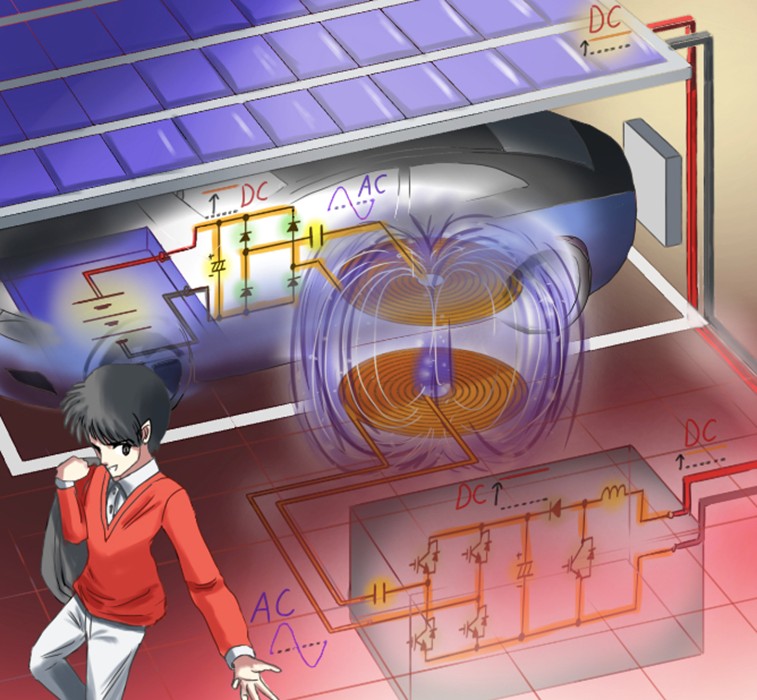
When applied to EVs, this technology could bring about a future where vehicles automatically charge simply by parking. Further advancements could even set up charging lanes on highways, allowing cars to charge their batteries while driving. That would greatly reduce concerns about range and make EVs more accessible and convenient.
When we hear about environmental measures or energy conservation, negative aspects like cost or constraints might come to mind first. Yet advances in power electronics can enhance convenience and comfort, creating new value and new business opportunities. Ultimately, considering the future of next-generation mobility means reflecting on how we wish to live and work in the future.
* The information contained herein is current as of July 2025.
* The contents of articles on Meiji.net are based on the personal ideas and opinions of the author and do not indicate the official opinion of Meiji University.
* I work to achieve SDGs related to the educational and research themes that I am currently engaged in.
Information noted in the articles and videos, such as positions and affiliations, are current at the time of production.