


Providing reasonable accommodations is now a legal obligation for businesses, regardless of disability certification
The Act for Eliminating Discrimination against Persons with Disabilities has been revised, and service providers’ duty to make efforts to provide reasonable accommodations for persons with disabilities has become a legal obligation. Moreover, the scope of application, which had previously been determined based on recipients of disability certificates, has now been expanded to include all individuals who continually face limitations in everyday life due to disabilities or social barriers, regardless of disability certification, as well as persons with mental or developmental disabilities and disabilities caused by intractable diseases.Autism spectrum disorder (ASD), a developmental disability, is characterized by difficulties in communication and restricted and highly focused interests. These characteristics exist on a spectrum, ranging from mild to severe, and the manifestation and severity of symptoms vary widely among individuals. Therefore, some people face difficulties without having received a diagnosis. In addition, it is known that atypical sensory characteristics, such as hyperesthesia, and a tendency to become easily confused by unexpected events often interfere with school life and outings.
As individuals with invisible disabilities are often misunderstood as being dependent or egocentric and have difficulty expressing their problems accurately when seeking accommodations, they have tended to receive insufficient support. Regarding sound that I specialize in, some people have a general aversion to loud sounds, some are affected differently depending on the type of sound, and some have poor selective listening skills, which makes it difficult to distinguish the voice of the person they are speaking with. Additionally, there is a wide variety of individual symptoms, such as excessive reactions to light or smell. Public awareness of the need to accommodate them seems to have been limited.
When considering disability, there is a concept called the social model of disability, which holds that society’s architectural and urban structures are responsible for the inconvenience that persons with disabilities experience. The UK, the Nordic countries, the US, and Australia actively promote such improvements through national policies and social systems.
In Japan, the Standard Architectural Design for the Smooth Transportation of Elderly and Disabled Persons, based on the Act on Promotion of Smooth Transportation, etc. of Elderly Persons, Disabled Persons, etc., the so-called Barrier-free Act, which came into force in 2006, was also revised in May 2025. With this revision, provisions were added to address difficulties faced by persons with invisible disabilities, and this took effect the following month. Japan is also developing and implementing legislation by following foreign policies.
Development of sensory-friendly social environments to address diverse needs
Sensory-friendly social environments have been developed in various places in Japan. Expertise such as architectural environmental engineering that we researchers have is also utilized to promote them.
In supermarkets in the UK and Australia, for example, “quiet hours” are set on specific days or at certain times to make shopping easier for people who have trouble with bright lights or loud noises.
In 2018, based on such initiatives overseas, Kawasaki City in Kanagawa became the first city in Japan to introduce quiet hours. We also provided advice on how to reduce environmental stimulation, and later, Kawasaki City developed guidelines for businesses. Now, drugstores and home appliance stores also have quiet hours.
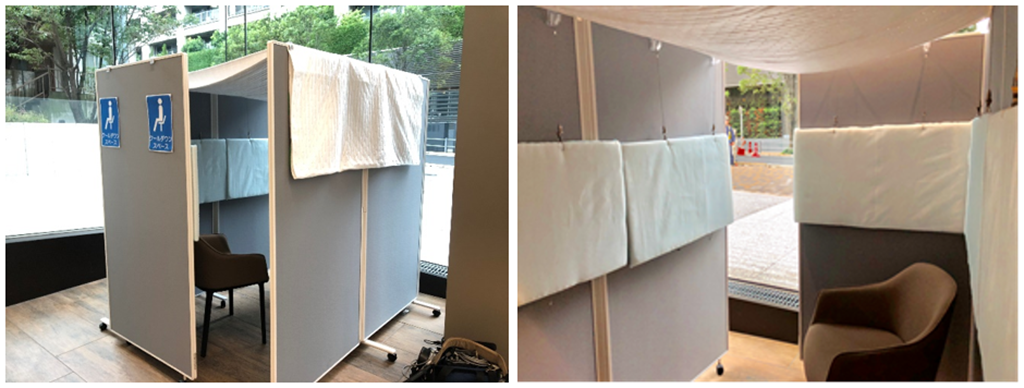
Also in 2018, the first movie preview called sensory-friendly screening was held in Kagurazaka in Tokyo. This initiative lowers the volume during loud scenes, allows people who cannot sit still during the screening to enter or exit the theater freely, and provides a calm-down space where they can regain their composure. The Autism Society Japan and other relevant organizations also provided cooperation for the initiative. Since then, it has gradually spread nationwide. We also work on developing guidelines for service providers while helping with screenings in Minato City and Kochi Prefecture.
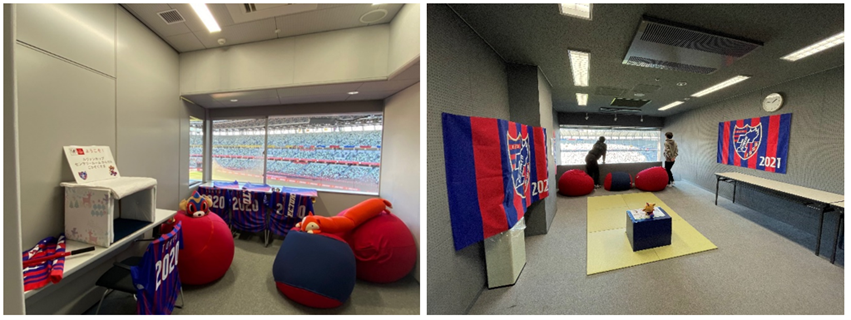
Regarding sports viewing, initiatives have been taken mainly at soccer stadiums. Since around 2019, following the lead in the UK, sensory rooms have been provided at the Uvance Todoroki Stadium by Fujitsu in Kawasaki City, the Japan National Stadium, and the Ajinomoto Stadium in Chofu City for children who have difficulty watching games in noisy general seating. In recent years, they have been installed permanently in new stadiums, such as those in Hiroshima, Osaka, and Kobe.
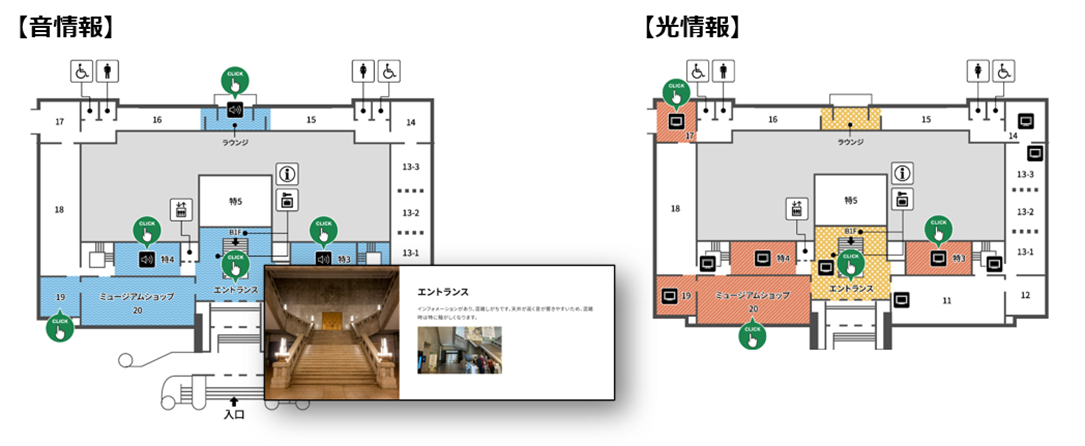
The development of sensory maps, which are available at museums in the UK and the US, is also gradually progressing. These maps visualize sensory stimulation by marking places that have distinctive lights or sounds. The maps help persons with ASD, who become easily confused by unexpected events, cope with such situations through prediction in advance.
In 2022, when the Tokyo National Museum created a sensory map to commemorate its 150th anniversary, our laboratory was responsible for surveying and measuring the environment in the museum, on the basis of the interview results with stakeholders. Sound stimulation can vary: the atrium at the entrance has strong echoes, while the air curtain in the lounge is noisy when the automatic doors open. We incorporated and integrated the opinions of stakeholders, who asked for information provision, including qualitative aspects.
Sensory elements such as sound and light are invisible and often considered difficult for society to understand. However, the initiatives do not require advanced technology, and simple measurements using a smartphone can serve as a reference. If the barriers for businesses can be lowered, it should become much easier to raise public awareness. Our laboratory is working on providing information to develop guidelines for sensory-friendly events and sensory maps. If we develop guidelines that indicate the qualitative characteristics of environments prone to sensory stimulation, as well as quantitative criteria, such as “Exceeding this value indicates strong stimulation,” we can expect them to be adopted nationwide.
We should promote the provision of reasonable accommodation according to sensory characteristics
Since sensory issues are invisible and can be unrecognized by the person, their family, or caregivers, they may not be addressed appropriately. Educational and awareness-raising activities are another approach to improving social environments.
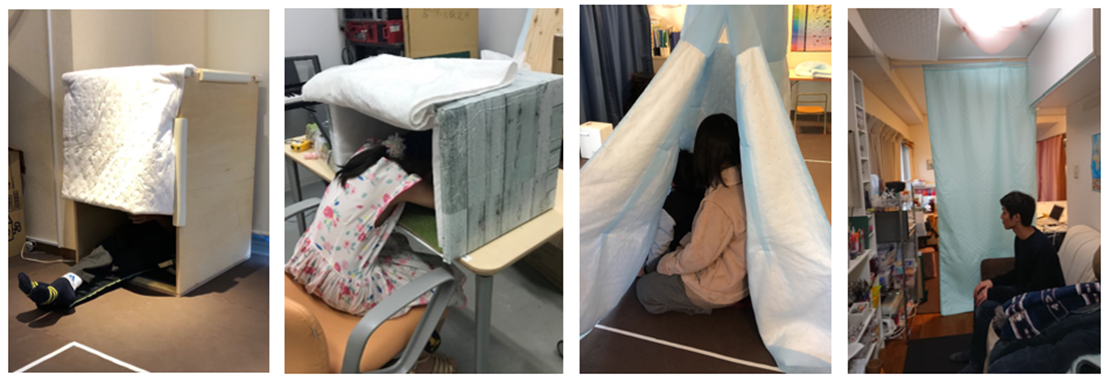
For example, in some special needs education classes, cardboard boxes are used to enclose the working space to block out noise. However, this feels extremely heartbreaking to me. From our professional perspective, the efficient use of sound-insulating and sound-absorbing materials to enhance functionality can create a space that is noticeably quieter than the surrounding environment.
We provided a space for adjusting the sound environment, which can be created for as little as 10,000 yen, for nursery schools and schools. When its effects were examined, clear results were observed, where children who had had daily panic episodes, ending up harming themselves or others, experienced fewer panic incidents when they used the space to rest during breaks.
The provision of reasonable accommodation obligated under the Act for Eliminating Discrimination against Persons with Disabilities is for the employer to examine and provide appropriate accommodation after receiving a request from the individual. Therefore, if the individual does not know what is helpful, it will not be utilized. Furthermore, without the understanding of the people around them, the accommodation may be considered as a special favor and end up not being implemented in practice.
What is needed is an environment where the individual can speak up and the people around them understand them. As the specific types of available support and accommodation are not yet well known in practice, it is also necessary to broaden understanding among the adults around them, as well as the children.
As part of efforts to address this issue, our laboratory has been conducting workshops and classes for children, childcare service providers, teachers, and caregivers. On our website, we have published classroom content packages for elementary schools, as well as guides for creating and using aids for adjusting the sound environment. By holding workshops at the Japan Academy of Learning Disabilities and the Association for Children’s Environment, we have had more opportunities to witness growing understanding.
If the social environment is successfully improved, there is no doubt that teachers’ workloads in schools will be reduced. Nevertheless, it is difficult for busy teachers to improve the environment through trial and error on their own. In the first place, it is necessary to widely share the fact that the environment can affect performance and how different adjustments can bring specific effects.
Many individuals have grown up without realizing that their sensory characteristics hindered them from understanding lessons and caused difficulties in learning. It is also essential to create a system that allows individuals to realize as early as possible that learning their sensory characteristics and appropriate support can reduce the difficulties and challenges in their everyday lives.
Since the challenges of invisible disabilities vary from person to person, their actual situations are difficult to grasp. Consequently, initiatives to create sensory-friendly social environments have not yet sufficiently progressed. I believe that recognizing the barriers for some people in our immediate surroundings, as well as raising awareness that the improvement of the environment can help them, will accelerate such improvement.
* The information contained herein is current as of August 2025.
* The contents of articles on Meiji.net are based on the personal ideas and opinions of the author and do not indicate the official opinion of Meiji University.
* I work to achieve SDGs related to the educational and research themes that I am currently engaged in.
Information noted in the articles and videos, such as positions and affiliations, are current at the time of production.
